.jpg)
Air Conditioner Installation Guide in Kenya and East Africa
Installing an air conditioner correctly is essential for efficient cooling, lower energy consumption, reliable performance, and a longer system lifespan. Whether you're installing a split air conditioner in a home, a ducted system in an office, or a commercial HVAC system in a large building, professional installation makes a significant difference.
Critical Cooling Systems provides air conditioner supply, installation, repair and maintenance in Kenya and across East Africa, serving residential, commercial, industrial, hospitality, retail, healthcare and institutional clients. This guide walks through the installation process, the types of AC systems we install, what to consider beforehand, and why professional installation matters.
What Is Air Conditioner Installation?
Air conditioner installation is the process of selecting, positioning, mounting, connecting, testing and commissioning a system to provide effective temperature control. A professional installation involves more than mounting an indoor unit on a wall — it includes selecting the right capacity, inspecting the site, positioning both units, running refrigerant copper piping, installing condensate drainage, connecting electrical power, pressure testing, vacuuming the system, charging refrigerant where needed, and commissioning.
Types of AC Installations We Handle
Split air conditioners — common in homes, offices, shops, restaurants and hotel rooms. A typical system has an indoor evaporator unit, outdoor condensing unit, refrigerant copper pipes, electrical cabling, a condensate drain and a remote controller.
Ducted air conditioners — suited to offices, hotels, restaurants, retail premises and hospitals where air is distributed through ductwork to multiple rooms or zones, with equipment concealed above the ceiling.
Cassette air conditioners — ceiling-mounted units for offices, shops, restaurants, hotels, showrooms and conference rooms, distributing air evenly across the room.
Commercial air conditioning — for buildings needing more than a standard split unit: hotels, retail centres, schools, hospitals, warehouses, server rooms and industrial facilities, sized to occupancy, heat load and ventilation requirements.
The Installation Process
- Site survey and assessment — room size, ceiling height, occupancy, windows, solar exposure, electrical supply and existing HVAC are all reviewed before specifying a system.
- Selecting the correct capacity — expressed in BTU/h, kW or tons, sized to room dimensions, insulation, occupancy, equipment load and sun exposure. Undersized units struggle to cool; oversized units short-cycle and handle humidity poorly.
- Positioning the indoor unit — for good airflow, clearance, maintenance access and secure mounting, away from obstructions.
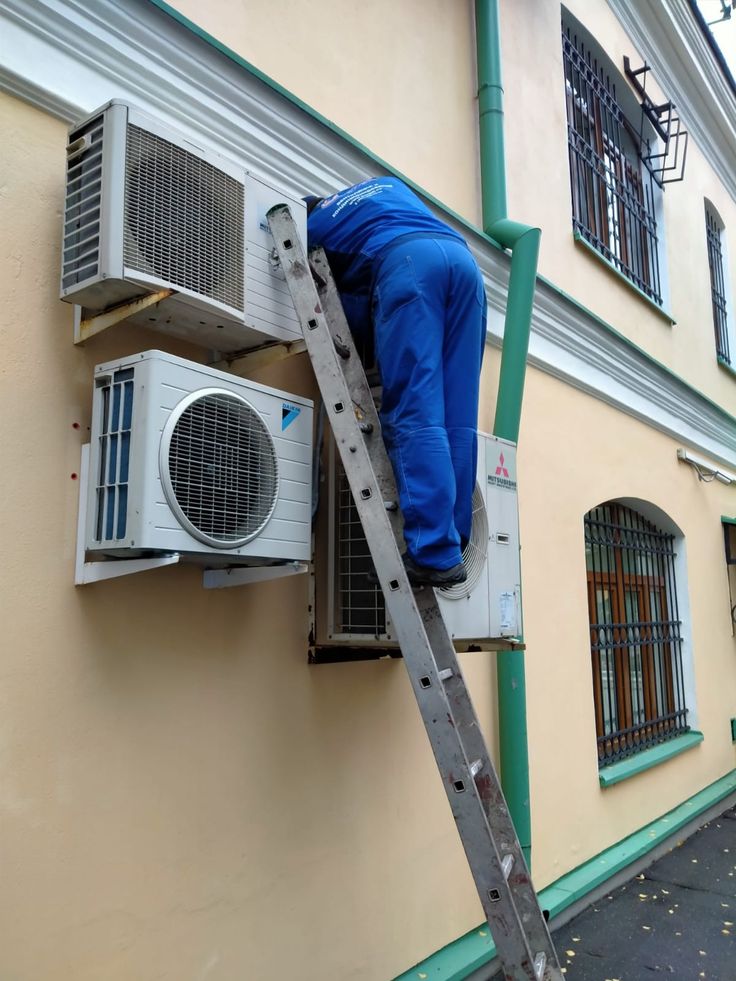
- Installing the outdoor unit — on a wall, roof, service yard or platform with adequate airflow clearance, since the condenser needs to reject heat effectively.
- Refrigerant copper piping — correctly sized, insulated and brazed, with neat routing and protected bends to prevent leaks and compressor strain.
- Condensate drain installation — properly sloped and routed to prevent leakage, ceiling damage and blockages.
- Electrical installation — power cables, breakers, isolator switches, earthing and control wiring, carried out by a qualified professional.
- Pressure testing — checks the refrigeration pipework for leaks before the system is charged.
- Vacuuming the system — removes air and moisture from the refrigeration circuit ahead of commissioning.
- Refrigerant charging — to the manufacturer's specification, adjusted for pipe run length where required.
- Testing and commissioning — cooling performance, temperatures, pressures, current draw, drainage and controller operation are all checked before handover.
Why Professional Installation Matters
Correct installation delivers better cooling performance, improved energy efficiency, longer equipment life, fewer refrigerant leaks, and far easier maintenance down the line — because the technician who installed it also left proper access to the equipment.
Common Installation Mistakes
- Selecting an AC that's too small for the room
- Installing the outdoor unit where airflow is restricted
- Poor refrigerant pipe sizing, insulation or brazing
- Improper condensate drainage
- Skipping pressure testing or vacuuming the circuit
- Incorrect electrical connections
- Poor indoor unit positioning
- Neglecting regular maintenance after installation
Where We Install
We install across Nairobi and surrounding areas, with projects in Kiambu, Mombasa, Nakuru, Kisumu, Eldoret, Machakos, Naivasha, Thika and other parts of Kenya — and we support air conditioning and refrigeration projects across East Africa, subject to location and project requirements.
Maintenance After Installation
Installation is only the beginning. A recommended maintenance visit covers filter cleaning, evaporator and condenser coil cleaning, refrigerant level checks, electrical inspection, condensate drain cleaning, fan and motor checks, and an overall performance test. Systems running continuously, or operating in dusty or high-traffic commercial environments, generally need more frequent servicing than a lightly used residential unit.
What Does Installation Cost in Kenya?
Cost depends on the type of air conditioner, cooling capacity, brand and model, number of indoor units, refrigerant pipe length, installation height, electrical and drainage requirements, ductwork, and overall complexity. A professional site assessment is the only reliable way to quote accurately — which is why we recommend one before any final installation price is given.
It depends on the type and complexity of the system. A standard split AC installation is usually quick, while ducted, multi-unit and commercial installations take considerably longer.
Yes — in existing homes, offices, shops, hotels and commercial buildings. The approach depends on available space, electrical supply, drainage and routing requirements.
Yes, including equipment positioning, ductwork, refrigerant piping, drainage, electrical connections, testing and commissioning.
Yes — cleaning, inspection, troubleshooting, refrigerant system checks, electrical inspection and performance testing.
Yes — supply and installation from one provider, so you get the appropriate equipment and professional fitting in a single job.
Need an air conditioner installed? Contact us for a site assessment and quotation, or read the original post on our live blog ↗.
